

Sign Up For Our eNewsletter
Get the latest news, happenings & more from the Chelan-Douglas Land Trust.


Plants and wildflowers add to the beauty of our foothills and improve the air and water quality, enrich and maintain the soil, sustain wildlife and provide humans with food and medicine.
We hope this field guide enhances your enjoyment of our local wildflowers, grasses, shrubs, and trees. Learning their names brings a sense of familiarity that will develop as you continue to visit the Wenatchee Foothills and watch the progression of plants through the seasons. We hope that your growing appreciation of these plants will encourage you to preserve them for future generations.
Resist the impulse to pick these beautiful wildflowers! Picking a wildflower prevents the next hiker from enjoying the same beauty. It also reduces the plant’s chance for survival, impacting the insects and animals that rely on it for food and shelter. Why not leave them for everyone to enjoy?
For an expanded list of common plants of the Wenatchee Foothills, click here.
Interested in growing native plants in your garden? Visit one of our local nurseries for plants or seeds.
Widespread throughout the Sage Hills, long-leaf phlox presents a brilliant display of condensed pink or white flowers. The predominant flower color is pink but may vary to blue, lilac-purple, or white. The flower is distinctively five-lobed. This plant has a highly variable growth form in that it can be sprawling and climbing over sagebrush, or a compact low mound four to sixteen inches tall. The leaves are numerous, narrow, unnotched, and often sharp-pointed, and, as the name suggests, long relative to the plant -- a half inch up to three inches. Phlox has a deep taproot.

Meadow death camas has a single stem, eight to twenty inches tall, with long four to twelve inch grass-like leaves at its base. At first the flowers form a rather dense pyramidal cluster. Later the cluster becomes more elongate and the individual flowers more widely spaced. The flowers can be white, cream-colored, or pale yellow. The plant grows from a bulb that looks like an onion but does not smell like an onion. The slightly elongate bulb buries itself progressively deeper as the plant ages.
Death camas contains several complex poisonous alkaloids and Native Americans called it the “poison onion”. The entire plant is potentially lethal if eaten. Even honeybees can be fatally poisoned from feeding on the nectar. The symptoms of poisoning include dizziness, nausea, and profuse vomiting. The Native American antidote was ingesting large quantities of fish oil.
Death camas often grows in the same habitat as blue camas, an important food crop for Native Americans. No one would mistake the small white flowers of death camas for the big blue blooms of camas, but mistakes occurred when the two populations were intermixed and both had gone to seed or withered—the time when camas bulbs were best for eating. If great care was not taken, the similar looking, but very poisonous death camas could be collected by mistake. Blue camas fields were often weeded of death camas to reduce the risk and make harvesting easier. Death camas has killed more people in the Northwest than any other plant.

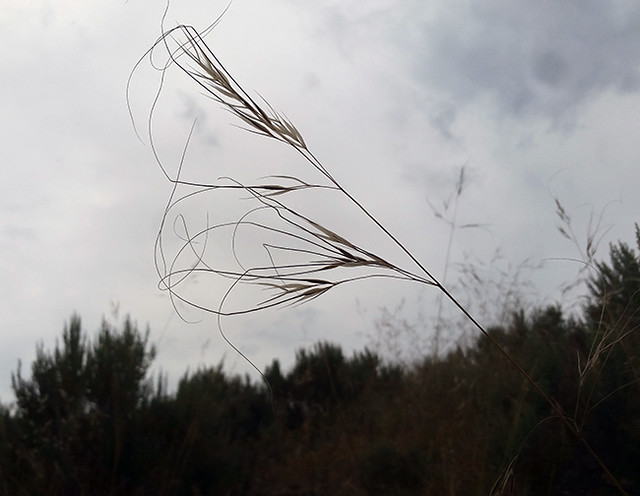
Form: Bunch grass, in small, widely spaced tufts. Its name comes from the 4- to 5-inch long twisted awn (a long needle-like projection extending from the fruit) which detaches from the seedhead with the seed and gives the appearance of a short needle and long thread.
Height: 1 to 3 feet
Seedhead: Loosely spreading and 4 to 8 inches long
Seeds: Seeds are long-lived; reproduces from seeds
Stems: Erect, unbranched stems
Leaves: Long, flat leaves 1 to12 inches long
Roots: Shallow-rooted to medium-rooted. Profusely branched roots grow both vertically and laterally.
Ecology: Prefers open sandy soil or sand dunes. Dormant in summer. Moderately to highly drought resistant.
Fire tolerance: Needle-and-thread grass can sprout following fire, if the heat has not been sufficient to kill the underground parts.
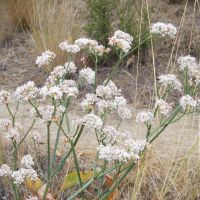
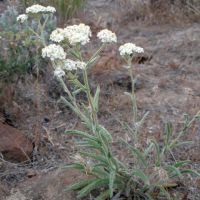
The parsnip-flower buckwheat is a long-lived plant with woody stems that branch at the base and small, narrow, densely hairy or woolly basal leaves. It grows in clumps about two feet broad and sixteen inches high. Small white or yellow flowers form dense single or multiple umbrella-like clusters at the end of the upright, nearly leafless stems. Each flowering stem produces one or more ball-like clusters of flowers, usually whitish-yellow becoming pinkish with age.
As a group, desert buckwheats may be one of the most important plants of the shrub-steppe, collectively providing the single most important nectar source for bees in this ecosystem. Also, their seeds provide a major food source for birds and rodents.
Native Americans boiled different parts of the buckwheat in water to drink as a cure for colds, tuberculosis, and syphilis, to apply on sores, and to use as a wash in the sweathouse.

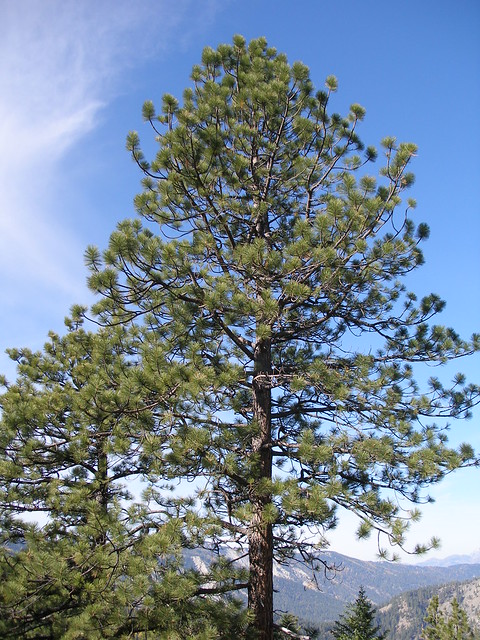
Ponderosa pine bark matures from very dark brown to a light reddish brown, becomes very thick, and, with all its plates and scales, looks like jigsaw puzzle pieces. The bark has a distinctive vanilla smell. The five to eleven inch long needles grow in bunches of three. The back of each scale on the cone is armed with a sharp spike. Ponderosa pine seeds are prized by birds, squirrels and chipmunks. The caches of seeds that they create help the tree spread its seeds by means other than wind.
Ponderosa pine grows in the Sage Hills because it is well adapted to drought. Its deep taproot seeks out water during the summer, and it is able to close its leaf pores to prevent water loss better than other conifers. The waxy coating on its needles minimizes water evaporation.
Ponderosa pine also does well in environments shaped by frequent fires. The tree facilitates frequent burning by providing plenty of ground fuel in the form of dropped cones and needles that contain a flammable chemical. The thick bark protects the living inner cambium tissue from damage by wildfire heat. Ponderosa pine seedlings are able to withstand exceedingly high temperatures (162 degrees F) at the ground surface, so fires do not kill them as easily as competing vegetation. Mature trees have a branch-free trunk extending high above the ground because often the lower branches are pruned by repeated fires.
Ponderosa pine ranks second to Douglas-fir in lumber production in the Northwest. Most knotty- pine paneling comes from young ponderosas.
Native Americans found many uses for ponderosa pine. The tree’s sugar-rich inner bark, or sap layer, was harvested in late spring by removing the outer bark with axes and sharpened poles. The inner bark layer (much like thin plastic wrap) could be eaten directly. Stems and limbs were used as building material and for firewood. The sap was applied as a salve or ointment. They boiled the needles to make a brew taken for cough and fever. The pitch was used as a glue and a waterproofing agent. Dried pitch was chewed as gum. Needles and fine roots were woven to make baskets. Twigs served as twirling sticks to start fires, and the trunks were hollowed out for dugout canoes.
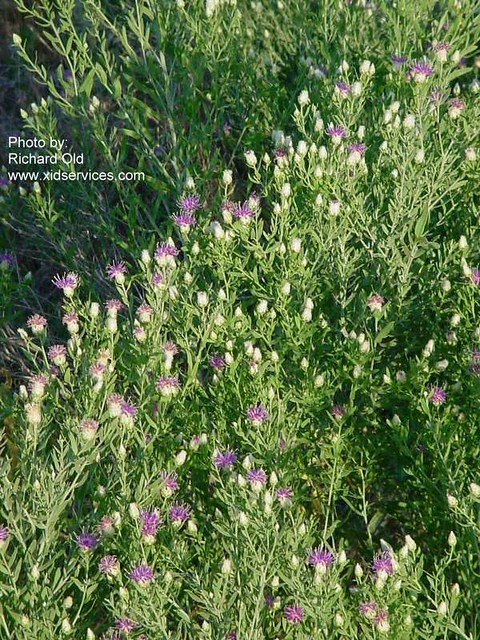
Russian knapweed grows up to three feet tall with considerably branched stems. Leaves up to six inches long and one and a half inches wide grow near the base of the plant and become smaller toward the top. The small half-inch flower heads on the branch tips may be white, pink, or lavender-blue. The stems die back after flowering in the summer and new shoots are generated in spring. Russian knapweed multiplies by sending out shoots underground. It also produces small quantities of seeds, which can live in the soil for two to three years, allowing the plant to take hold in new areas.
Knapweed is thought to inhibit the growth of neighboring plants by releasing allelochemicals into the soil. It is also toxic to horses if they eat sufficient quantities. Under most circumstances livestock avoid grazing Russian knapweed because of its bitter taste.
Controlling Russian knapweed can be difficult. Removing the above-ground growth only encourages the plant to send out new underground shoots. Hand pulling is very difficult and doesn’t remove enough of the root system to prevent it sending out new shoots. The sap of Russian knapweed may irritate the skin so it is recommended to wear gloves when handling it. Mowing will reduce the plant’s seed production if done before the seeds are set.
Russian thistle, also known as tumbleweed, is a dense intricately-branched plant forming a round bushy clump one to three feet tall. Stems and branches vary in color from green to red, often with darker stripes. It has many rigid and spine-tipped, narrow, fleshy leaves and bracts, which are soft when young but become dry and brittle with age. The leaves grow one half to one inch long, with lower leaves as long as two and a half inches. Small inconspicuous flowers appear at the base of the leaves and look like papery saucers with a pink or reddish center.
Russian thistle has a taproot descending five feet below the plant, in addition to horizontal roots spreading out about six feet around it. This long taproot can extract deep soil moisture that is not available to other plants.
When Russian thistle plants die in the fall, they break off from their roots at the base of the stem. Their circular shape allows them to tumble freely in the wind, often for many miles, scattering seeds as they go. Large plants can produce up to 100,000 seeds, which can remain alive in the soil for one to three years. Plant “skeletons” (the part that tumbles) persist for at least one year and are typically found along fences and other structures.
As a noxious weed, Russian thistle is not an aggressive competitor. It does not replace native species, but takes advantage of disturbed areas, such as along roadsides and fence lines and new structures. It does all its growing during late summer when the water supply has essentially been depleted, by combining efficiency in water retention, storage, and absorption.
Russian thistle can be controlled by hand pulling, but that can be difficult given its spiny nature. Always wear gloves. Other methods of control are cutting, mowing, or tilling. Two insects have been approved for biological control. Controlling seedlings in the areas where the skeletons collect can be very effective.
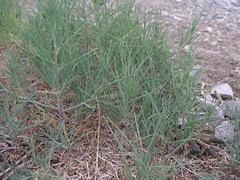
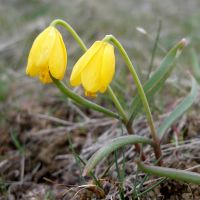
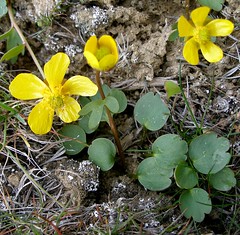
Showy and widespread throughout the
Buttercups contain a potent skin irritant, called protoanemonin, that causes redness and blistering of the skin and mucous membranes. Native Americans often used it on their arrowheads as a poison. The whole plant was used to poison coyotes. A poultice of mashed and dampened whole plants was used to alleviate pains of any kind. A poultice of mashed leaves was also used for warts.
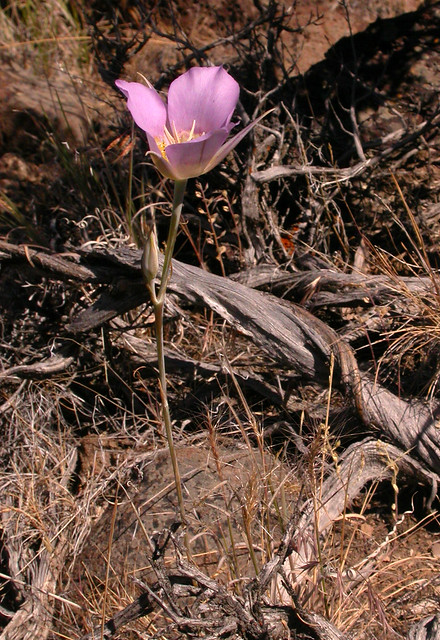
Sagebrush mariposa lily is showy and grows up to two feet tall, with a beautiful tulip-like flower that displays petals, sepals and stamens in multiples of three. Each plant has one to three flowers, and the lavender petals are pointed at the tip, with a darker violet band at the base. The stems grow stout and erect and unbranched from a round starchy bulb, and the leaves are long and grass-like and curled at the tip.
The bulb, one of the first to be dug in the spring by the Native Americans, is sweet when roasted or can be eaten raw or ground into a starchy meal.
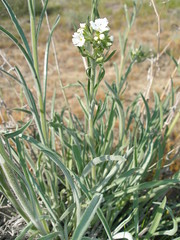
Sagebrush stickseed flowers are white and showy but tiny, less than half an inch wide, and the simple petals look just like a child would draw a basic flower. The leaves are coarse, hairy, and rather short, two to seven inches long, with a cluster at the base and smaller leaves going up the stems. The stems branch at the base into multiple flowering branches, growing eight to twenty-eight inches tall. The name stickseed describes the seeds of this plant which are covered by minute, branched barbs or prickles that facilitate the seed’s dispersal by sticking to fur and clothing.
Online Resource

Trail maps, directions, more info

40 Years of Conservation Success
