
Sign Up For Our eNewsletter
Get the latest news, happenings & more from the Chelan-Douglas Land Trust.


Plants and wildflowers add to the beauty of our foothills and improve the air and water quality, enrich and maintain the soil, sustain wildlife and provide humans with food and medicine.
We hope this field guide enhances your enjoyment of our local wildflowers, grasses, shrubs, and trees. Learning their names brings a sense of familiarity that will develop as you continue to visit the Wenatchee Foothills and watch the progression of plants through the seasons. We hope that your growing appreciation of these plants will encourage you to preserve them for future generations.
Resist the impulse to pick these beautiful wildflowers! Picking a wildflower prevents the next hiker from enjoying the same beauty. It also reduces the plant’s chance for survival, impacting the insects and animals that rely on it for food and shelter. Why not leave them for everyone to enjoy?
For an expanded list of common plants of the Wenatchee Foothills, click here.
Interested in growing native plants in your garden? Visit one of our local nurseries for plants or seeds.
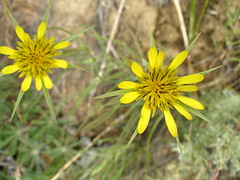
Salsify produces multiple stems one to three feet tall that when torn emit a milky sap. The leaves are long and very narrow. Each branch produces one flower head. The daisy-like yellow flowers open early in the morning and often close by late afternoon. The longer the days the more likely it is to flower. Later the plant forms a seed head that resembles a dandelion but is distinctly larger. The seeds themselves are long but featherweight. These seeds break easily from the flower and can travel long distances in the wind. The seeds typically survive in the soil for less than a year.
Salsify has broad tolerance to climatic conditions and grows in a wide variety of soil types. Some experts consider it an invasive weed but others suggest that salsify is not aggressive and that control is seldom necessary. Studies and observations suggest that salsify's survival, growth, and reproduction may be reduced by the presence of neighboring vegetation. In any control or management plan, salsify's importance to wildlife should be considered.
Livestock and wildlife utilize salsify, sometimes extensively. Flower and/or seed heads are consumed by sage-grouse, dusky grouse, pronghorn, and white-tailed deer.
Salsify has been used to treat dog or coyote bites, boils, sore throats, and internal injuries of horses. Young salsify leaves, stems, and roots are edible. Local Native Americans chewed the coagulated milky sap like gum before swallowing it. The fluffy pappus (featherlike hairs) on the fruits was used to make “cotton” for stuffing pillows.
Form: Bunch grass, in small tufts usually 6 inches across
Height: Up to 1 foot
Seedhead: Slight purplish tinge and up to four inches long
Seeds: Produces from seeds and tillers (shoots); produces significant amounts of seed in most years
Stems: Slender stems with many small seedheads on short upright branches
Leaves: Leaves smooth, deep blue-green, and folded with keel-shaped tips typical of bluegrasses
Roots: Strong fibrous root system; shallow-rooted
Ecology: Common and widespread native grass. One of the first plants to start growth in early spring. Adapted to wide variety of soils. Inhabits thinner, drier soils than bluebunch wheatgrass, often growing on lithosols. Relatively short lived. Leaves wither and go dormant in dry conditions. Because it is shallow-rooted, it must complete growth and seed production early before available soil moisture has been depleted.
Fire tolerance: Generally unharmed by fire
Uses: Seeds used for food by the Native Americans
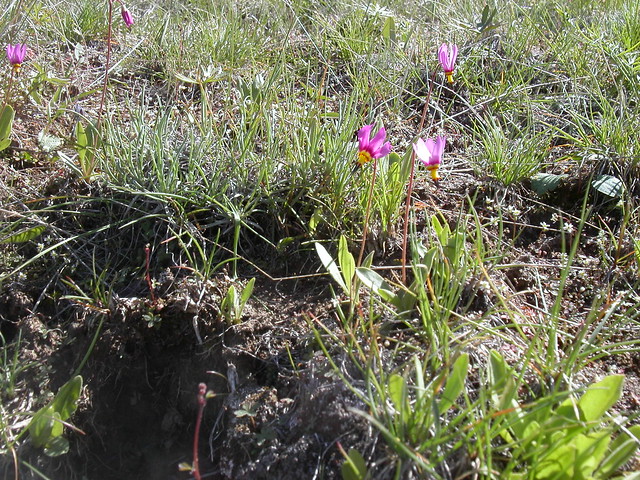
Shooting star has flowers at the top of leafless stems two to sixteen inches tall. The leaves are smooth and oblong, one to six inches long, and grow from the base. The unusual shaped flower is easily identified by the five pink petals pulled back from five colorful stamens, nodding toward earth like a “shooting star”. It has also been described as a jet-propelled missile with its “nose-cone” being the showy yellow stamens and pistil. Some say it looks like the flowers are inside out.
Such an unusual flower requires a special technique for pollination. While hanging upside down, a bumblebee grasps the yellow band at the base of the petals. It then gives a quick buzz of its wings which shakes pollen out of the flower’s anthers and onto its abdomen. When the bee visits the next shooting star, the thin stigma protruding from the tube is perfectly placed to receive the pollen.
Shooting star was used medicinally by the Native Americans as a wash for sore eyes or for cankers. It was also used by women as a love charm and to help them control men.
Snow buckwheat is conspicuous because it flowers in late summer when other plants in its rocky habitat are dormant. Sometimes it grows so abundantly that the landscape appears dusted with snow. Snow buckwheat grows in clumps up to sixteen inches tall and wide. The crown gives rise to numerous short woody stems. Leaves attached to the main stems are short (less than three inches long) and generally oblong. The undersides of the leaves are gray and very “woolly” while the tops are only slightly hairy. The flowering stems are also woolly. The flowers are white or light pink and turn brown at seed maturity in the fall.
Mule deer make heavy use of snow buckwheat in the winter and early spring months. Small birds and mammals use the canopy for cover.
A tea brewed from the roots and stems of snow buckwheat was used by Native Americans as a cold remedy. A decoction of roots and stems was used to wash infected cuts and sores.

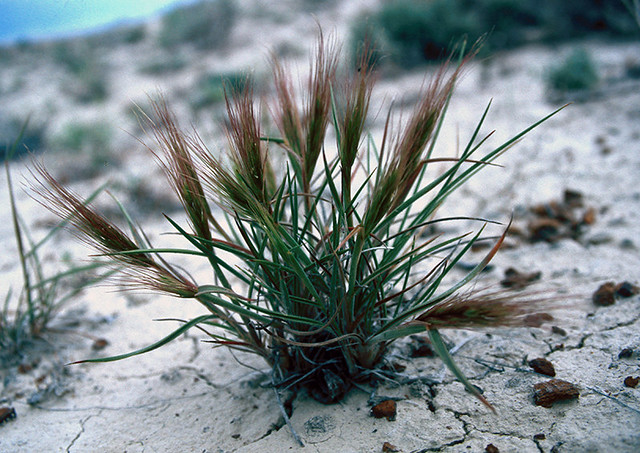
Form: Bunch grass; species of wild rye
Height: 6 to 18 inches
Seedhead: Dense, bristly spike, 1 to 3 inches long; looks like a bottlebrush or squirrel tail
Seeds: Reproduces from seeds. Seeds readily dispersed by wind
Stems: Erect
Leaves: Blades rolled or flat, rather narrow
Ecology: Drought tolerant and adapted to a wide range of soils. Most abundant on disturbed sites in either deep or shallow soils. Very effective for wind and water erosion control due to its persistent ground cover. This species can coexist with cheatgrass.
Fire Tolerance: One of the most fire-resistant native bunchgrasses.
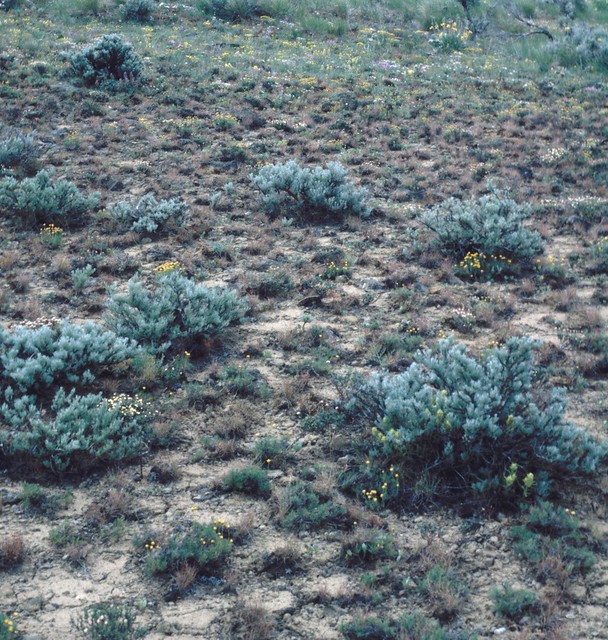
Stiff sagebrush is a low mounding shrub, strongly scented with the characteristic sage odor. It is low and spreading with a conspicuously woody base. The base is often heaved from the soil by frost action. The trunk is very irregular, spreading above the base in a dense cluster of short, rigid, and rather brittle branches up to sixteen inches in length. It grows up to two feet tall in dry rocky and thin soil steppe lands, where it becomes the dominant species.
Stiff sagebrush stems are woody, yellowish, and hairy when young, becoming gray and shredded with age. The deciduous leaves are one half to one and a half inches long, wider at the tip, and divided into three to five narrow lobes and are covered with silvery white dense short hairs. The white and inconspicuous flowers bloom in summer.
All sagebrush is wind pollinated, and the seeds are very small. Most seed falls beneath the plant and the plant community moves three feet or less per generation.
Stiff sagebrush is of high value to wildlife because they are commonly found along exposed ridges where snowmelt occurs rapidly, and they supply the only available forage to big game animals in the early spring months. Western sage-grouse also feed from stiff sagebrush.
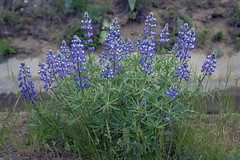
During late spring in the Sage Hills, the wide open sunny slopes are colored with a blue-to-purple hue. The flowers are lupines, a common shrub-steppe wildflower. Lupine can be recognized by its tall, spike-like cluster of blossoms. The flower itself has two lips that look, from the side view, like a parrot’s beak. The lupine leaf is palmate with five or more leaflets radiating outward from a single point on the stalk. The stalks are silvery to slightly rust colored from the dense covering of hairs.
Silky lupines are more robust, and grow one to three feet tall. Leaflets are one to four inches long, and the flowering stems jut up above the leaves. It can be distinguished from sulphur lupine by the absence of a dense basal cluster of leaves and a strikingly hairy appearance. Silky lupine tends to bloom after the sulphur lupine.
Within the roots of many legumes, including lupine, are nodules that house symbiotic bacteria. These bacteria contribute to healthy ecosystems by converting nitrogen from the atmosphere into forms plants can use. Scientists have discovered that lupine can nearly double the amount of nitrogen in soils, which is important for our own local nitrogen-deficient soils.
Lupines contain toxic alkaloids and can be very poisonous, although large quantities of the plant material must be ingested in a short time to cause death. Symptoms of lupine poisoning include dizziness and lack of coordination.
Native Americans used lupine as a natural dye.
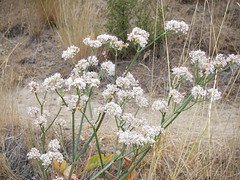
Buckwheats have branched stems one to three feet tall, and large, three to six inch, densely hairy, leathery basal leaves. The flowers, individually very small, form dense single or multiple umbrella-like clusters, called umbels, at the end of the upright, nearly leafless stems. Each small flower has three sepals and three petals. The color of the flowers varies among and within species from white to yellow to pink or reddish, but all tend to darken to yellow-red as they age.
Buckwheats provide an important nectar source for shrub-steppe bees. The seeds of desert buckwheats are a favorite food for many birds and rodents.
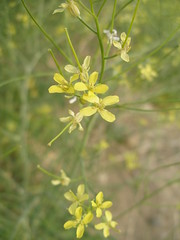
Tall tumblemustard is a plant with many branches growing from a single stem and a stout taproot. It is initially a low-growing rosette of basal leaves, but later becomes tall and lanky in appearance, growing up to five feet in height. The round stems are light green and mostly smooth, except for widely scattered white hairs. The widely-spaced alternate basal leaves are up to six inches long and whither with age. Small, pale-yellow flowers give rise to long linear seedpods up to five inches long. A single plant can produce up to 12,500 seedpods, with 1.5 million seeds.
In the fall, the dried parent plant breaks off at the base of the stem and its circular profile allows it to “tumble” across the landscape. The seedpods are tough and shatter slowly, so only a few seeds at a time are released. In our windy climate, the seeds may be dispersed over miles and miles of terrain throughout the fall and winter. With this effective seed dispersal method, tumbleweed could be a highly invasive weed. It is prolific but it does not require special control measures. It requires full sun and poor soil, so as other plants fill in or the ground is covered with plant debris, tumblemustard is outcompeted. Small infestations of tumblemustard can be controlled by hand pulling the rosettes in the fall or early spring.
Tumblemustard may be confused with Russian thistle, which is another tumbleweed. However, tumblemustard is much less dense, has a light straw color, and is not as prickly as Russian thistle.
Tumblemustard attracts honeybees and butterflies. The greens can be used in salads.
Online Resource

Trail maps, directions, more info

40 Years of Conservation Success
