Sign Up For Our eNewsletter
Get the latest news, happenings & more from the Chelan-Douglas Land Trust.


Plants and wildflowers add to the beauty of our foothills and improve the air and water quality, enrich and maintain the soil, sustain wildlife and provide humans with food and medicine.
We hope this field guide enhances your enjoyment of our local wildflowers, grasses, shrubs, and trees. Learning their names brings a sense of familiarity that will develop as you continue to visit the Wenatchee Foothills and watch the progression of plants through the seasons. We hope that your growing appreciation of these plants will encourage you to preserve them for future generations.
Resist the impulse to pick these beautiful wildflowers! Picking a wildflower prevents the next hiker from enjoying the same beauty. It also reduces the plant’s chance for survival, impacting the insects and animals that rely on it for food and shelter. Why not leave them for everyone to enjoy?
For an expanded list of common plants of the Wenatchee Foothills, click here.
Interested in growing native plants in your garden? Visit one of our local nurseries for plants or seeds.
Thompson’s paintbrush is not a colorful plant, unlike other paintbrushes. The yellow to green “flowers” are actually modified leaves hiding the inconspicuous tubular flowers. The petals fuse into a narrow, elongate tube. The stems are in clusters and usually grow four to sixteen inches tall. Short white hairs cover the stems and leaves.
Paintbrush is able to take water and organic material from a host plant’s root system, thus obtaining more water and nutrients than it could obtain by itself in dry conditions.

Thread-leaf fleabane daisy has daisy-like flowers with white, pink or purple petals, and a large yellow center. Growing four to twenty inches tall, the stems are hairy and branch extensively, forming large symmetrical clumps. Individual stems may support one to several flower heads. The narrow light-green leaves, one half to three inches long, inspire the name, thread-leaf. “Fleabane” comes from its reputation for destroying or driving away fleas.
Native Americans drank a decoction of this plant for general illness, backache and cracked bones. The leaves were chewed for sore throats, or chewed up and spit on sores. Toasted leaves mixed with grease or mashed fresh plants were used as a salve for pains, sores, swellings, and wounds. The juice, sap, or thorns of these plants may cause a skin rash or irritation.

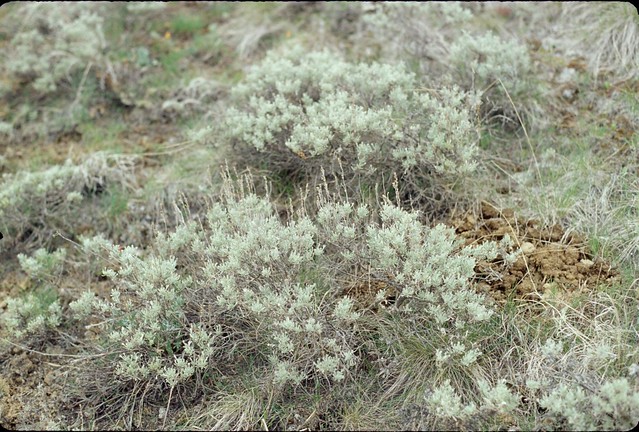
Three-tip sagebrush is a rounded, freely branching, evergreen shrub. Its leaves are gray-green, long, and deeply cleft into three lobes. The stems are a smooth pale gray. Three-tip sagebrush carries the distinctive sage fragrance, especially when wet. The flowers are green and inconspicuous. It has a very slow growth rate, reaching a height of one foot after twenty years, and a mature height of four feet. Three-tip sagebrush is intolerant of shade.
The light seed of three-tip sagebrush is wind dispersed but this plant can also sprout from shallow, lateral roots or the root crown, and in some cases, by layering. In layering, a branch or stem comes in contact with the soil and sends out roots. Once rooted, the branch can be severed from the mother plant, roots and all, and planted elsewhere.
Three-tip sagebrush is not a preferred browse in the Sage Hills but is used occasionally by mule deer in both summer and winter. Jackrabbits, chipmunks, and pocket mice forage on the plant.
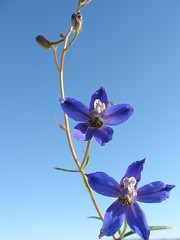
The upland larkspur’s striking blue flowers are borne at the end of a short stem which ranges from six to sixteen inches tall. The flower has five widespread petals that grow together to form a hollow flower with a spur at the end, giving the plant its name--the spur reminiscent of a lark. The leaves are deeply lobed, one to two inches wide, and grow mostly from the base. The plant is hairy, varying from sparse to dense and matted or sticky.
Larkspurs kill more cattle on summer range than any other plant or disease. It is acutely toxic. Cattle that eat a lethal dose die within five hours from respiratory paralysis.
For millennia the alkaloid-bearing seeds have been ground-up to poison lice. Larkspur flowers were used for a natural dye.
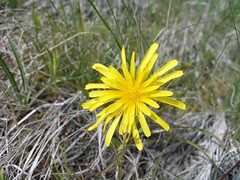
The microseris resembles a dandelion, with a leafless stem supporting a single head of bright-yellow ray flowers. The plant can reach of height of two to twelve inches. The basal cluster of leaves, narrow and strap-like with wavy edges, are sparsely to densely covered with hairs. Its flowering head closes early in the day, especially during hot weather, and the plant then becomes inconspicuous and non-showy. The flower matures to a dandelion-like seedhead and each of the seeds, or achenes, has a “parachute” that aids in wind dissemination.
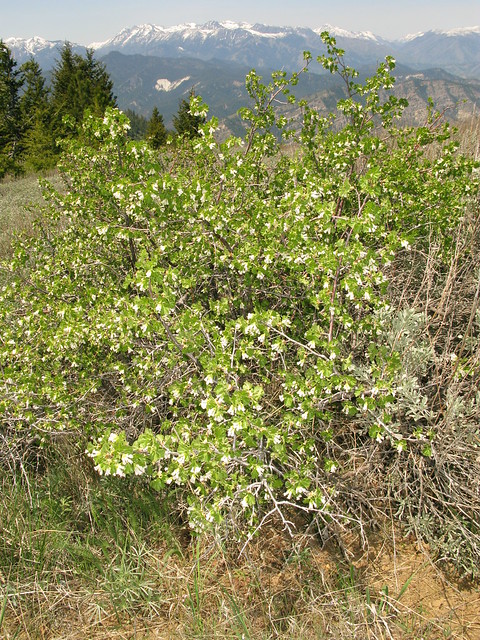
Wax currant is a compact but erect, many-branched, fragrant shrub that grows about four feet tall. The waxy, gray-green leaves are fan-shaped, generally in three to five less-defined lobes with gently scalloped edges. The often-sticky hairs on the younger branches, leaf stalks, flowers, and fruits contribute to its strong, unpleasant, carrion-like odor.
Spring-blooming flowers are creamy white to pale yellow, tubular, and about half an inch long and form small clusters at the end of short stalks along the branches. The fruit is a red or orange berry about a quarter-inch in diameter. The berries are edible, although seedy and tasteless.
Wax currant provides food and cover for wildlife. Chickadees and other birds eat the fruit. It is not as valuable for deer, but it is used on ranges where little else is available.
Native Americans used the wax currant berries for pemmican, the source of the name "squaw-berry." Eating a large quantity of the fruit may cause a burning sensation in the throat. They used the wood of the wax currant for arrow tips. An infusion of inner bark was used to wash sore eyes.
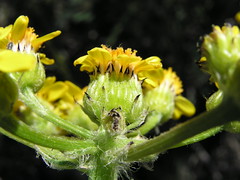
Western groundsel is a fairly tall plant (eight to twenty-eight inches) with a single upright stem and large, smooth-edged leaves. Although daisy-like, groundsels appear flat-topped with several to numerous small, yellow heads borne near the tips of equal-height branches. Young plants are covered with white loose hairs that are lost in older plants. Most of the leaves grow from the base and are up to ten inches long and two inches wide. The upper leaves become progressively smaller. Each head produces about twenty smooth seeds with long white bristles to carry them away in the wind.
The groundsel species contain poisonous alkaloids but are sufficiently unpalatable that livestock seldom eat them.
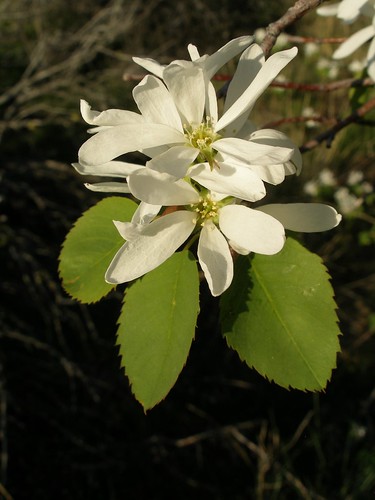
Western serviceberry derives its common name not from “serving” but from Sorbus, the Latin name for mountain-ash, because its leaves look much like mountain-ash. It is a large, variable-sized, common shrub in the Sage Hills. In spring, it bears many attractive and fragrant white flowers.
Serviceberry stems and leaves are valuable as a browse for wildlife, particularly deer. The berries turn bluish-purple when ripe, and are juicy and tasty but pithy. The berries are one of the earliest fruits to ripen, and provide a staple food source for birds and coyotes.
Western serviceberry was also a valuable source of food and tools for Native Americans. Its hard, straight wood was used for arrows, root-digging sticks, and seed-beaters. The berries were dried alone or squeezed into cakes and dried. The berries were also used as a sweetener for other foods. In winter, serviceberries were boiled to make a pudding or added to a stew. Hunters made a snack of a mixture of dried salmon and serviceberries.
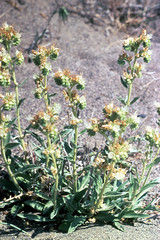
The name “white-leaf” refers to the silky-white hairiness of the leaves of this phacelia. Dense short hairs lend the plants an overall grayish-green color. The plant grows up to twenty inches tall. Roughly the upper half of the plant consists of branched flowering coiled clusters. Flowers are crowded in small clusters on one side of the stalk that are coiled into twisted "S" shapes. Each cluster has many small white or purple flowers. The numerous dark stamens are conspicuous because they protrude far beyond the flower petals and give the appearance of bristles. Each flower produces a tiny capsule with one or two seeds. This plant prefers sandy soil.
Phacelia have been called scorpionweed because the curling flowerhead resembles a scorpion’s tail.
A drink boiled from phacelia was consumed by Native Americans for difficult menstruation.
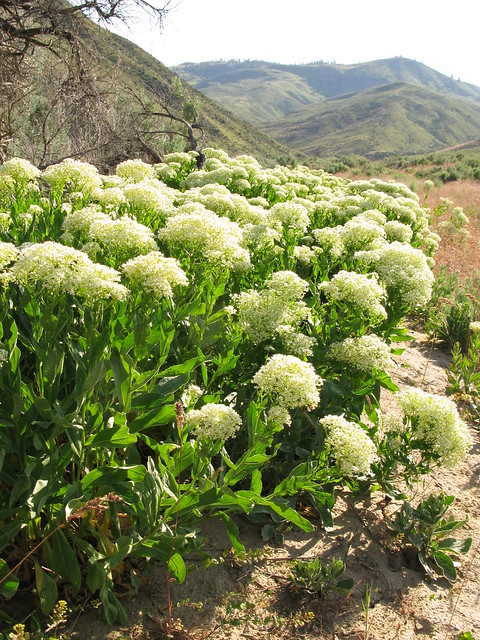
In the Sage Hills, whitetop often forms a sea of sweet-smelling white flowers. Whitetop grows upright from a single stem eight to twenty inches tall. The flower head is typically flat-topped and dense with white flowers. Flowers have four widely-spaced petals. The lower leaves form a rosette at the base of the stem and are somewhat hairy and lance-shaped and two to four inches long. Higher on the plant, the leaves clasp the stem with two ear-like lobes and have fewer hairs.
Whitetop is an invasive weed that forms dense patches that can completely dominate sites, restricting the growth of other species. It spreads primarily by extremely persistent roots and will eventually eliminate desirable vegetation and become a monoculture. One plant can produce 1200-4800 seeds, and buried seeds remain viable for three years. In absence of a competitor, a single plant can spread over an area twelve feet in diameter in a single year.
It is difficult to control whitetop due to its perennial root system, abundant seed production, and ability to survive in diverse habitats. Pulling it or mowing before it flowers and sets seed reduces seed production but does not eradicate existing populations.
Online Resource

Trail maps, directions, more info

40 Years of Conservation Success
