Sign Up For Our eNewsletter
Get the latest news, happenings & more from the Chelan-Douglas Land Trust.


Plants and wildflowers add to the beauty of our foothills and improve the air and water quality, enrich and maintain the soil, sustain wildlife and provide humans with food and medicine.
We hope this field guide enhances your enjoyment of our local wildflowers, grasses, shrubs, and trees. Learning their names brings a sense of familiarity that will develop as you continue to visit the Wenatchee Foothills and watch the progression of plants through the seasons. We hope that your growing appreciation of these plants will encourage you to preserve them for future generations.
Resist the impulse to pick these beautiful wildflowers! Picking a wildflower prevents the next hiker from enjoying the same beauty. It also reduces the plant’s chance for survival, impacting the insects and animals that rely on it for food and shelter. Why not leave them for everyone to enjoy?
For an expanded list of common plants of the Wenatchee Foothills, click here.
Interested in growing native plants in your garden? Visit one of our local nurseries for plants or seeds.
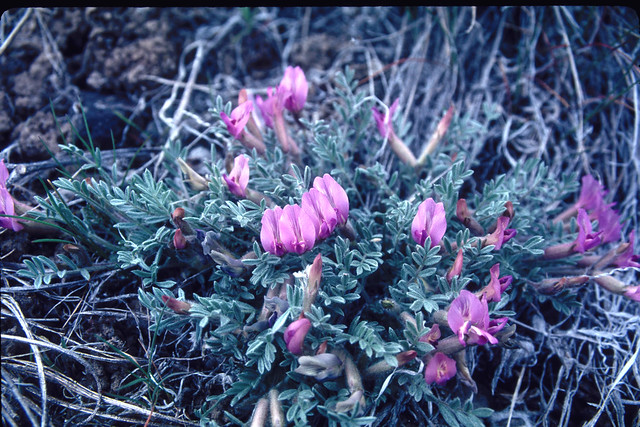
This low-growing, cushion-like plant has white, pink, or purple flowers that mature and produce distinctive white woolly seed pods. The stems are only two to four inches long. The leaves are the gray-green color of sagebrush. Like all legumes, locoweed helps to fix nitrogen in the soil.
The name, locoweed, derives from the Spanish word for “crazy”. It refers to the effect most plants in this family have when a large quantity of the plant is consumed over a period of several days—an otherwise calm animal can become aggressive, run around with an odd gait, run into objects with its head held low, and finally, keel over dead. Crazy is an apt description. Livestock never recover completely from the poisoning. However, woolly-pod locoweed is a preferred food source for sage grouse, which eat the leaves and seeds.
Native Americans mashed and boiled the plant in water to use as a head and body wash to stimulate circulation.
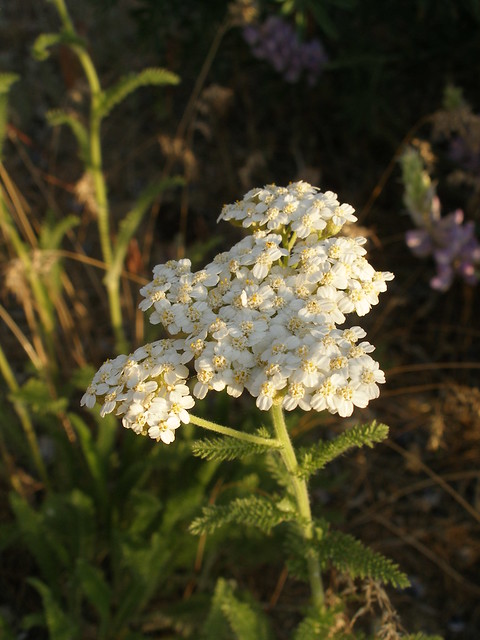
Yarrow has one to several tall upright stems up to three feet tall, narrow fern-like leaves clustered at the base but found on the stem as well, and flat umbrella-shaped clusters of dense white flowers. One of its main characteristics is the odor of the crushed leaves--a strong aromatic herb rather like rosemary and sage. Yarrow has a weedy look to it and is often found in disturbed areas.
The plant has a long and fabled history as a powerful healing herb used topically to staunch bleeding from wounds, cuts, and abrasions. The scientific name is derived from the mythical Greek hero, Achilles, who reportedly carried it with his army to treat battle wounds. It is also called staunch weed and soldier's woundwort.
In the Northwest, Native Americans used yarrow to treat colds, flu, bladder trouble, venereal disease, sore eyes, diarrhea, stomach cramps, and dysentery.
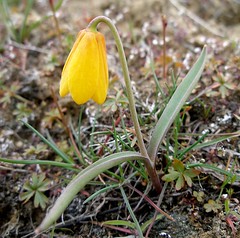
One of the first spring flowers in the Sage Hills is the distinctive bright yellow bell. Its nodding bell-shaped flowers grow singly or in pairs on the end of a short stem, four to twelve inches tall. They tend to become more orange as they age. The narrow smooth leaves grow one to six inches long and in pairs or groups of three or more near mid-height on the stem.
The root of yellow bells is a nutritious bulb that was one of the first to be dug in the spring. It tastes like sweet potato and was considered a delicacy. It was eaten raw, steamed or boiled.
Online Resource

Trail maps, directions, more info

40 Years of Conservation Success
