


Sign Up For Our eNewsletter
Get the latest news, happenings & more from the Chelan-Douglas Land Trust.


Plants and wildflowers add to the beauty of our foothills and improve the air and water quality, enrich and maintain the soil, sustain wildlife and provide humans with food and medicine.
We hope this field guide enhances your enjoyment of our local wildflowers, grasses, shrubs, and trees. Learning their names brings a sense of familiarity that will develop as you continue to visit the Wenatchee Foothills and watch the progression of plants through the seasons. We hope that your growing appreciation of these plants will encourage you to preserve them for future generations.
Resist the impulse to pick these beautiful wildflowers! Picking a wildflower prevents the next hiker from enjoying the same beauty. It also reduces the plant’s chance for survival, impacting the insects and animals that rely on it for food and shelter. Why not leave them for everyone to enjoy?
For an expanded list of common plants of the Wenatchee Foothills, click here.
Interested in growing native plants in your garden? Visit one of our local nurseries for plants or seeds.
Douglas-fir is one of the world’s strongest, straightest, fastest-growing trees. It is the most abundant tree in the Northwest, and a major commercial lumber species in
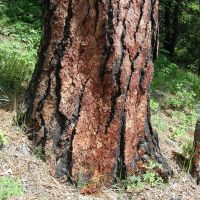
Douglas-fir bark is smooth and has resin-filled blisters like true firs when trees are young, but once the trunk is about twelve inches in diameter, the bark grows furrowed and corky. If you were to cut the bark with a knife, it would have wavy bands of light tan and dark brown, like the pattern in a pile of sliced bacon. The needles are about an inch long and are attached to all sides of the twigs. They are not sharp or prickly to the touch. They are green on the upper surface and have two white bands (of microscopic pores) on the underside. Unlike true firs, the cones hang from the branches. The cones have distinctive, three-pronged, pitchfork-shaped bracts projecting from the scales of the cone that look like the tail of a mouse hiding in the cone.
Douglas-fir seeds can sprout in partial shade. In closed stands the tree’s lower branches die and eventually fall off, so live foliage often occupies only the upper third of the main trunk. Older trees have very thick bark which allows them to survive moderate surface fires, but even low-intensity fires will kill most Douglas-fir saplings.
Native Americans used Douglas-fir in many ways. The foliage was used as a body freshener in conjunction with sweat baths. The needles were boiled as a substitute for coffee. The branch tips were used for tea. A decoction of bark was taken for coughs and colds. A gum from the pitch was used for sore eyes. The active growing shoots of the needles are said to be a good source of vitamin C. Boughs were used as thatching and flooring, and to line cooking pits, serving to flavor the food as well as protect it from burning. And sapling wood was used for dip-net hoops and shafts, berry drying racks, and snowshoe hoops.

The brodiaea or wild hyacinth has a cluster of pale to dark blue, tubular flowers with six wavy lobes or “petals” atop a single spindly stem. These stems can grow twelve to eighteen inches tall from a bulb, with one or two grass-like leaves nearly as long as the stem.
Native Americans dug up the bulbs just before the leaves showed above the ground. These were eaten raw or cooked. When boiled, the bulbs have a sweet, nut-like flavor. The tender seedpod was eaten as a tasty green.

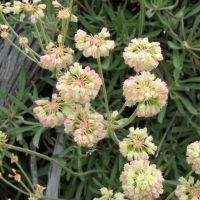
Dusty maidens have a highly branched stem up to two feet tall with a compact cluster of one to five inch long leaves at the base. The branches are tipped with white or tan flowers that look like pompoms. These flower heads are made up of tubular white flowers in a dense round cluster.
Dusty maidens may be easily confused with yarrow. The smaller white flower heads of yarrow are more umbrella-like. Yarrow has a distinctive fragrance which dusty maidens lack. Both plants have fern-like leaves but dusty maidens leaves are wider than yarrow. Native Americans called dusty maidens “rattlesnake-tail”, thinking its leaves resembled the rattlesnake’s rattle.
Native Americans used to drink a decoction of the plant as a stomach tonic, to relieve swellings, and for general lassitude. It was also used as a wash for chapped hands, skin eruptions, and insect or snake bites.

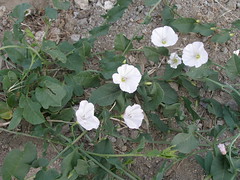
Field bindweed is a climbing or creeping vine that dies back each year. Its name derives from the way it binds or coils around other plants. The stems grow one to six feet long. The one- to two-inch-long leaves are spirally arranged and arrowhead-shaped.
Although it produces attractive white or pale pink trumpet-shaped flowers, field bindweed is often unwelcome as a nuisance weed because it grows rapidly and chokes other plants. It is ranked as agriculture's twelfth most serious weed species. It reproduces both from seed and creeping roots, and is found in extremely diverse environmental conditions. One plant can produce up to five hundred seeds that can remain viable in the soil for fifty or more years. A deep, extensive root system allows it to sprout repeatedly from fragments and rhizomes following removal of above-ground growth. Persistent hand pulling or tilling or shading will help control this plant.
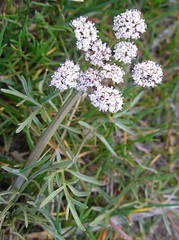
Geyer’s biscuitroot is often the first flower seen in the spring, blooming as early as February. It is easily identified by the tiny white flowers growing in umbrella-like clusters called umbels. Stems can be green or red, and its leaves attach to the stem at or below the ground surface. The dark-green, very narrow, divided leaves give off a strong, rather unpleasant, parsley-like odor. Biscuitroots typically bloom on a short stem which greatly elongates as the fruits ripen, growing two to three times the height of the initial stalk. This species grows to a final height of six to twelve inches.
Biscuitroot stores energy as starch in a fleshy, tuberous or bulb-like, root just a few inches below the ground. This root was a significant portion of the local Native American diet. The root was collected, eaten fresh, baked like a potato, or dried and then ground into flour. The roots were dug only after seeds set to avoid a taste like turpentine.
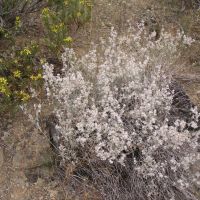
Gray rabbitbrush is very common in the Sage Hills. It rivals sagebrush in its wide distribution, but has a more limited range, requiring somewhat moister conditions and sandier soils. It is a deciduous shrub, with long narrow leaves and a height of two to four feet. White or gray woolly hairs densely cover the stems and leaves, and its foliage resembles the gray-green color of sagebrush. Rabbitbrush becomes very conspicuous when it blooms in late summer in a showy display of bright-yellow clusters of flowers. The rabbitbrush fruits are capped with many bristles that help the seeds spread in the wind.
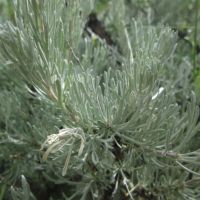
It is easy to confuse rabbitbrush and sagebrush. Both are medium-sized shrubs with gray, woolly hairs covering the leaves. Rabbitbrush lacks the strong sage odor and has narrow (linear), non-lobed leaves.
Rabbits do not prefer eating rabbitbrush, so the name may refer to their use of rabbitbrush for cover. Deer, antelope, and other range animals feed sparingly on the leaves, flowers, and young twigs.
Native Americans used rabbitbrush as forage for animals, fuel, candy (chewing gum), dyes, arrows, brooms, and as medicine for toothaches, coughs, colds, sores, and diarrhea.

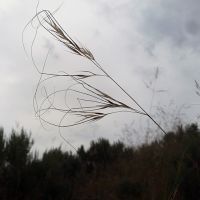
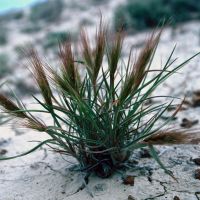
Form: Bunch grass; tall, native large wild rye. Largest cool-season perennial bunchgrass native to the western United States. Forms large clumps with dense spikes that resemble wheat.
Height: 3 to 5 feet
Seedhead: Thick bristly 6-inch flower spikes
Seeds: Reproduces by seed and rhizomes
Stems: Dense spikes that resemble wheat
Leaves: Up to 0.8 inch wide
Roots: Extensive soil-binding, fibrous root system, pushing as deep as 6 feet and as wide as 3 feet
Ecology: Thrives in moist, alkaline soils, though it is adapted to a wide range of other soil types. High water-use efficiency. Established stands can survive long periods of summer drought. Tolerant of partial shade. Grows in both disturbed and undisturbed soils.
Fire tolerance: Coarseness of foliage resists prolonged burning. Plants sprout from surviving root crowns and rhizomes.
Uses: Seeds were collected, roasted, winnowed, and ground to flour. Dried stalks were used for floor coverings and leaves sometimes used in weaving.
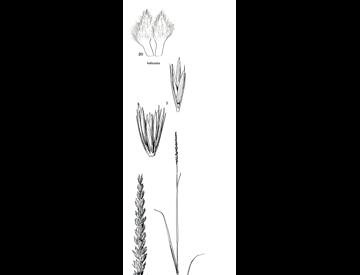
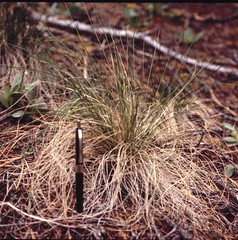
Form: Bunch grass; densely tufted; the flowering stalk resembles Sandberg bluegrass
Height: 7 to12 inches
Seeds: Reproduces from seeds
Stems: Erect, and densely tufted
Leaves: Numerous leaves 5 to 10 inches long that grow mainly from the base. Finely textured leaves are blue to gray-green.
Roots: Strong root system can extend 16 inches deep in a 4-inch diameter plant.
Ecology: Grows in deeper, moist soils. Slow to establish, but once established, has abundant growth of fine leaves that provide effective ground cover. Narrow environmental tolerance compared to the other grasses. Tough, fine, fibrous roots control erosion and improve soil structure. Retards or prevents the invasion of weeds once firmly established.
Fire tolerance: Highly susceptible to fire damage.
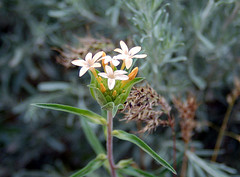
The large-flowered collomia grows from a single branching stem up to three feet tall with narrow leaves one to three inches long. The unusual peach- or salmon-colored blossoms with blue stamens at the center are arranged in many-flowered heads. Five petals fuse into a long, narrow tube concealing nectar at each flower’s base which only longer-tongued insects such as butterflies and moths can access. The violent expulsion of the seeds from the ripe capsule help the plant travel to new ground, and the mucilaginous threads of the seed coat may help the light seeds stick to the ground where they fall.
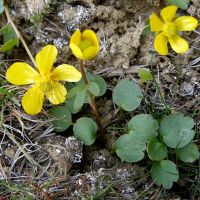
This fleabane has yellow daisy-like flowers, an unusual color for fleabanes that are usually purple or white. There are several short and erect flowering stems two to twelve inches tall, each bearing a single head. The many narrow elongate leaves, one half to three inches long, cluster predominantly near the base of the stems, giving the plants a cushion-like appearance. Linear-leaf daisy has adapted to complete its growth and reproduction quickly before entering into a long period of dormancy.
The Okanagan-Colville Indians used a decoction of the whole plant to treat tuberculosis. They also drank a brew of this plant for general illness, backache, and cracked bones. The leaves were chewed for sore throats, or chewed up and spit on sores. Toasted leaves mixed with grease, or mashed fresh plants were used as a salve for pains, sores, swellings, and wounds.

Online Resource

Trail maps, directions, more info

40 Years of Conservation Success
