Sign Up For Our eNewsletter
Get the latest news, happenings & more from the Chelan-Douglas Land Trust.


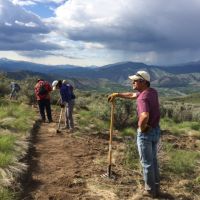
Forty for Forty: For the Love of Trail Buiding and the Burts Trail
by Barry Storer
My first volunteer work with the Chelan Douglas Land Trust (CDLT) was in the autumn of 2013. Under the direction of Hanne Beener, who much later would become the Executive Director of the organization, we assembled at the Saddle Rock Trailhead and wielded grub hoes and pick mattocks to decommission undesirable user-made trails. By that time of year, the tread had compacted to concrete hardness, making the work difficult and making me wonder whether I would do much more of this. Since that inauspicious start, however, I’ve carried a tool of some sort over almost every mile of Land Trust trails, sometimes maintaining an existing trail, sometimes helping to bring a new trail into existence.
There are many components to stewarding Land Trust properties, but building and maintaining trails in our local foothills is certainly one of the more important jobs and, for many of us, the most rewarding. Like many who volunteer for trail work, I had previously hiked hundreds of miles in various locations around the country, but had given little thought about how those trails were built. Usable and sustainable trails, I’ve learned, are rarely accidental. They are carefully designed to expose users to interesting details along the way, shed water by maintaining certain steepnesses or relationships to the fall line, and balance the needs of different users like hikers and bikers.
Building the trail is not haphazard either. You consider the angle of the cut slope (uphill) and fill slope (downhill), and the width of the tread. You create a slight outslope to the tread to
promote drainage. Additionally, you may construct water channels to further enhance
drainage.
My first experience building a new trail was at Castle Rock. The process was not dissimilar to building a fireline, with which I had previous experience. The first couple of workers broke up the sod, the next couple cleared it away, and each successive couple refined an assigned aspect of the tread. A notable memory from that first experience was cutting into the slope and cutting across the burrow of a rattlesnake, which indignantly poked its head out before retreating deeper into the earth. The crew worked in a slight detour (which is still visible) around the burrow.
Later work parties had me helping with the building of the Glacier View, Balsamroot, Upper
Apricot, and Burts trails. Each of these trails had sections that cut through hills with a moderate slope where a mini-excavator, run by a skilled operator, saved a tremendous amount of manual work. In all these cases, hand tools and volunteer workers were still needed for many of the finishing touches of the trail.
A well-built trail in our foothills does not require as much maintenance as a forested trail, but it still requires ongoing stewardship. Drainage ditches may need to be cleared, brush may need to be trimmed, a section of tread may need rebuilding, or signs may need installation or replacement. Sometimes newer trails need native flowers, grasses, or shrubs planted to crowd out invasive weeds, prevent erosion, or mitigate the visual impact of a cut slope. Sometimes good stewardship simply means taking measures to keep people away during the mud seasons of early spring or late fall when the trail’s surface is easily damaged by boots or tires.
Hiking all the trails I’ve helped build evokes memories of the work – debating the best route, sweating to level the surface through rocky ground, designing a particularly tricky switchback, or carrying heavy work materials back to the trailhead a mile away. Although the work was physically demanding at times, the memories help me appreciate each of these trails in a deeper way than walking a trail to which I’m a stranger.
Trip Details: Walking the Burts Trail
The last trail on CDLT property that I helped build is a short, pleasant path on the Horse Lake Reserve known as the Burts Trail. The Horse Lake Reserve is composed of several large properties (two of them being old homesteads) that the Land Trust purchased between 2006 and 2008. One of these homesteads was the 660-acre property that the Burts Family ranched and farmed from the early 1900s until late in the century. Even after the matriarch and patriarch of the homestead had passed, their children, who had moved into town or farther afield, kept aspects of the ranch active until 2001. Eventually, none of these activities were economically viable, the children themselves grew old, and keeping the property in the family no longer made sense. Nonetheless, it pained the surviving family members to think about development dividing up this beautiful, wild property where they grew up. Working with the Land Trust to include the homestead within the Horse Lake Reserve, the family was able to preserve the property as they had loved it and contribute a valuable asset to the community.
Access: Drive up Horse Lake Road to its end and park on the edge of the circle just
outside the gate blocking access to the Old Ranch Road.
Trip Instructions: The following description travels in the direction providing the best views across the valley to the mountains beyond.
–From the gate, hike the Old Ranch Road just over a mile to the major left-turning switchback. At certain times in the spring, this route is recommended for viewing flowers, especially when balsamroot, lupine, and phlox are all blooming simultaneously.
–At the switchback, you’ll find the lower end of the Glacier View Trail and the upper end of the Burts Trail. For a longer hike that doubles the length of the featured hike, go 0.75 miles farther up the Old Ranch Road to the upper end of the Glacier View Trail and hike the Glacier View Trail 2 miles back to this switchback. For this featured hike, however, turn off the road at the switchback and hike the Burts Trail as it winds gently downhill 1.4 miles to the site of Burts Barn (now just a cement slab). Ignore the spur branching downhill off the main trail at about 0.9 miles.
– You’ll know you’re at the end of the Burts Trail when you see the cement slab and the old yellow bulldozer. To complete the loop, hike up the gravel road (Burts Barn Connector) about a quarter mile, then take a short path on the right leading back to the car.
Trip Stats: Round-trip distance is 2.75 miles (5.5 miles if adding the Glacier View Trail). Elevation gain is 400 vertical feet (900 vertical feet if adding the Glacier View Trail).
Allowed: Hikers, trail runners, mountain bikers, horseback riders, are all welcome. Leashed dogs are also allowed but come prepared to carry out their waste.
Not allowed: No motorized use, camping, campfires, hunting, shooting, picking of plants, off-trail travel, or littering.
Upcoming Events: Join the Land Trust on Tuesday, October 7, from 12 – 3 pm for a hands-on work party at Jacobson Preserve. The group will plant native species, restore habitat, and maintain trails on the preserve. Tools, gloves, and snacks will be provided. Bring sturdy shoes and a willingness to get your hands dirty. Sign up at the CDLT office in downtown Wenatchee or online at cdlandtrust.org (registration required) and help improve the health of the foothills.
Barry Storer is emeritus faculty at the Fred Hutchinson Cancer Center in Seattle and an avid hiker and backpacker. In recent years he has joined numerous work parties with the Washington Trails Association to maintain trails in the Okanogan-Wenatchee National Forest.
Forty for Forty. Recognizing the 40th Anniversary of the Chelan-Douglas Land Trust with 40 stories about places the CDLT has protected and kept open for public access.
Online Resource

Trail maps, directions, more info

40 Years of Conservation Success
