Sign Up For Our eNewsletter
Get the latest news, happenings & more from the Chelan-Douglas Land Trust.


Forty for Forty: December Trails and Winter Closures
by Andy Dappen
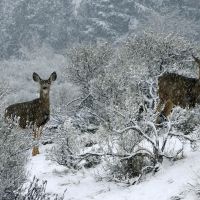
December 1: It’s a sad day for local outdoor enthusiasts as all the trails in the Sage Hills and Horse Lake Reserve (and specific trails elsewhere) close for the winter. At the same time, wildlife occupying such areas (specifically mule deer) have been known to perform a collective celebratory jig over the coming quietude. Humans mourning, deer dancing … it’s obvious proof of the conservation of happiness – a well recognized cosmic constant.
In the cohort of those of us leaking happiness, it’s not uncommon to hear disgruntled hikers grousing about the deer with such comments as, “I don’t see why they need protection…you see them all over town in winter eating everyone’s shrubs and flowers.”
As is so often the case, personal observations are partial truths when the whole picture is more complicated. All species of animals (deer being no exception) have outliers exhibiting different characteristics than the norm. In the case of deer behavior, some will be notably bolder and some notably shier than the norm, and the survival of the species sometimes depends on the outliers.The boldest individuals who browse in town might be more likely to survive winter, while the shiest individuals might be the least likely to end up in a freezer come hunting season.
It’s important to recognize that the deer venturing into town are not your average doe. The large majority of deer remain in the hills and are skittish of two-legged creatures (or barking four-legged creatures). Most will expend considerable calories avoiding contact with these threats at a time when almost no calories are replacing that effort. For some members of the herd, eliminating these disturbances makes the difference between surviving or perishing over the winter. This goes double for many of the females who are pregnant throughout the winter and will be delivering the next generation come late May or early June.
Besides helping wildlife, the winter trail closures in the foothills provide a complimentary benefit: They protect soft trail surfaces during the muddy months when use damages the tread and accelerates erosion. The many different landowners of our foothills trails have finite financial and volunteer resources for trail maintenance, so keeping paths in good shape for most of the year by closing them when they are easily damaged is sensible (or centsible) management.
That’s two sound rationales to be a good citizen and observe the winter trail closures. Here’s a third reason to clinch the argument: None of the trail closures are on properties belonging to us individually and, if we want the continued privilege of using these lands, we should set aside personal desires, suck it up, and abide by what the landowners ask.
Details: Foothills Winter Closures
Although our regional foothills trails see a number of closures, many trails in the area remain open. Below are the parcel-by-parcel details to observe.
Dry Gulch Trails. Only the Dry Gulch Main Trail (the gravel road leading to the top of the earthen dam sitting southwest of the trailhead at the end of Circle Street) is open for winter use. The other routes that branch off this road or that head up Rooster Comb are closed for the winter.
Saddle Rock Trails. All trails in the Saddle Rock Natural Area and the Jacobson Preserve remain open with the caveat discussed in last week’s article (stay off them if your feet or tires are leaving prints 1\4” deep or deeper). The Saddle Rock Main Trail is graveled and is the best alternative when rain or snow has muddied the smaller trails.
Castle Rock Trails. All trails in the Lower Castle Rock Natural Area and Castle Rock Ridge remain open with the caveat that these trails should not be used when recent rains or snows create muddy conditions. Also, the Land Trust asks visitors not to use the unmaintained, unauthorized trail up Chopper in winter – this route is hazardous when frozen or muddy and winter use accelerates damage to the ridgeline leading up the peak.
Sage Hills and Horse Lake Reserve Trails. All trails on these lands are closed from December 1 to March 31. This includes all trails leaving from the Sage Hills Parking area, Day Drive Trailhead, Kenzie’s Landing, and the Horse Lake Trailhead. Despite the trail closures, Horse Lake Road provides a place to recreate – the gravel portion of the road is gated and closed to motorized use throughout the winter, but remains open to walkers.
Cashmere Canyons Preserve Trails. The trails managed by the Land Trust on this private ranch are all closed from December 1 until early April by the land owner’s desire to protect the mule deer wintering on the property.
Mountain Home Ridge Trails. These trails above Leavenworth remain open until snowfall blocks access via Mountain Home Road.
Road Options. Many dirt and gravel roads in the region offer excellent alternatives for winter walking, riding, snowshoeing, or skiing. Roads to consider include: Orr Creek Road in the Stemilt Basin, Twin Peaks Road up Number 2 Canyon outside of Wenatchee, Burch Mountain Road above Sunnyslope, Tibbetts Mountain Road starting several miles up Olalla Canyon, King Creek and Five Mile roads on the way to Blewett Pass, Tronsen Meadows Road a mile before Blewett Pass, and Ranger Road on the edge of Leavenworth. Details about accessing and using most of these roads can be found in the online guidebooks maintained by WenatcheeOutdoors.org.
Land Ownership. The properties listed above are owned by a combination of private organizations (Dry Gulch LLC, Chelan-Douglas Land Trust), private individuals, utilities (Chelan PUD), and municipalities (City of Wenatchee). Despite the varying ownership, the large majority of the trails are managed by the Chelan-Douglas Land Trust.
Upcoming Events. For some winter fun the Chelan-Douglas Land Trust and NCW Audubon Society are hosting a free Nature-Themed Game Night on Thursday, January 15, 2026, from 4 to 6 p.m. at Yonder East Taproom. Drop in to enjoy nature-inspired board games like Wingspan and Bird Bingo, or bring your own game to share.
Andy Dappen is a former board member of the Chelan Douglas Land Trust. He hopes those using and enjoying Land Trust properties will join the organization ($50/year, cdlandtrust.org/support-us/become-member).
Forty for Forty. Recognizing the 40th Anniversary of the Chelan-Douglas Land Trust with 40 stories about places the CDLT has protected and kept open for public access.
Online Resource

Trail maps, directions, more info

40 Years of Conservation Success
