Sign Up For Our eNewsletter
Get the latest news, happenings & more from the Chelan-Douglas Land Trust.


Article in partnership with The Wenatchee World
by Grace Peven
I once believed only the brave or foolhardy ventured into our foothills after a hard rain. I feared the erosion, muddy shoes, specks of dirt that scattered over my legs and, most of all, the pungent and potent perfume of the sagebrush. After a downpour, so strong was the smell that it coated my nostrils and overpowered my senses.
Frankly, I haven’t been on particularly friendly terms with sagebrush –my sensitive nose can’t bear it. But, alas, Mother Nature’s children deserve attention and respect (though from a distance for me).
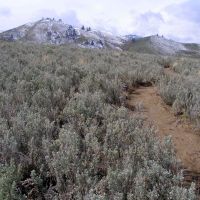
Artemisia tridentata (big sagebrush) is the predominant ‘sage’ in the foothills of Central Washington and it has many redeeming qualities. Why else would our ancestors have named it after Artemis, the Greek Goddess of hunting, childbirth, the moon, and the wilderness? When Artemis wasn’t chastising Agamemnon for killing a stag in her sacred garden, she frolicked in the woods, caring for nature’s flora and fauna. Because of the fruitfulness and prestige of sagebrush (it’s been used for everything from arrow cases to tea), Artemisia was considered a fitting namesake for the genus to which all three of our local sagebrushes belong. Tridentata, meanwhile, refers specifically to the three-toothed tips of the leaves that are characteristic of big sagebrush.
Big sagebrush lords over our other native sagebrushes not just in size and quantity, but also in age. The average lifespan of big sagebrush is 40-50 years. The occasional specimen hits the century mark because its finely tuned adaptations allow it to survive the bipolar moods of the desert.
Big sagebrush is one of a trio of sagebrushes in our hills. Artemisia tripartita (three-tip sagebrush) is an aromatic relative with woolier, three-parted leaves, and is often found growing alongside big sagebrush. Where soils become thin and rocky, a smaller, scruffier sagebrush, Artemisia rigida (stiff sagebrush), is also likely to be found. The leaves of stiff sagebrush look similar to those of three-tip sagebrush, but crush them and smell – they’ll exude a minty odor.
In the face of a drought, all sagebrushes guffaw. Dehydration is an unimaginable outcome for these survivors. To quench their thirst in our arid environment, they maximize rainfall absorption with thick networks of shallow roots. But they also send roots into the deep to mine underground water reservoirs. Not only are sagebrushes efficient water collectors, they are stingy water hoarders. The leaves of these plants are a lighter color and a bit ‘hairy’ – qualities that reflect the intense summer sun and reduce the desiccation of strong desert winds.
Along with such admirable adaptability, native people found the plants remarkably useful. When afflicted with a runny nose, sagebrush leaves up the nostrils slowed the sniffles, or so it was believed. These people used sagebrush to cure respiratory ailments and inhaled the smoke of smoldering sagebrush as a sedative.The leaves and twigs of the plant were also pulverized and then boiled to make a medicinal tea for colds, sore throats, indigestion, grippe (influenza), and general illnesses.
Sagebrush was also used by native peoples as fiber to create clothes, saddle blankets, arrow cases, sandals, and rope. And it was placed around the deceased during burial rituals as a deodorizer.
So the next time you’re recreating in the foothills, take a moment to appreciate and smell these powerfully pungent plants. For a few, like me, they might overpower your senses; for many others, they might cure your sniffles.
Details: Looping the Sagebrush
For a sagebrush-identifying hike that is slightly cooler (it is July, after all!) try this loop on the Horse Lake Reserve.
Access: From the north end of Wenatchee, drive Horse Lake Road until the paved road turns to gravel. Now follow the well-maintained gravel road 3.25 miles uphill until the road is blocked by the gate at the entrance to the Horse Lake Reserve. Park along the edge of the dirt circle at road’s end, being mindful of leaving room for other cars to turn around here.
Trip Instructions: Walk around the gate blocking the road and follow the gravel ranch road to a fork (0.4 miles). Take the left spur at this fork onto a double-track road that is grassier and steeper. Follow this grass road (called the Old Ranch Road) uphill for 0.6 miles as it contours in a generally northwesterly direction to a distinctive switchback and then heads south after the switchback. A half mile after the switchback, leave the Old Ranch Road by turning right onto the Homestead Trail. In about 100 yards, the Homestead Trail reaches a col (the rockier ground to the left and the right of the col offers the type of soil where you might expect to find stiff sagebrush). From the col, the trail makes many switchbacks as it heads downhill for two miles and then intersects the Lone Fir Spur. Turn left on the Lone Fir Spur and follow it to Horse Lake Road (0.75 miles). At the road, turn left and walk 0.4 miles back to your car.
Maps: See our attached CalTopo Map or this map from the Land Trust
Distance: Total distance of this loop: 5 miles. Elevation gain: 800 vertical feet.
Allowed: Hiking, trail running, mountain biking, dogs on leash (bag their poop).
Not Allowed: No motorized use, camping, campfires, hunting, shooting, plant removal, off-trail travel, or littering.
Land Ownership: This route is on property owned and managed by the Chelan-Douglas Land Trust.
Upcoming Event: Join CDLT for Sunset Zumba on Monday, July 14, 2025, from 7:30–8:30 p.m. at Horse Lake Reserve. Run in partnership with the YMCA, this free outdoor class offers a fun way to stay active while enjoying the summer evening views. A YMCA Zumba instructor will lead the session, and while the class is free, cash donations are welcomed at the event. Registration is required and space is limited, so sign up early to reserve a spot.
About the writer: Grace Peven grew up in Wenatchee and loves our foothills despite the aromatic power they sometimes exert upon her. In August, she will complete her PhD in Water Resources at the University of Idaho.
Forty for Forty. Recognizing the 40th Anniversary of the Chelan-Douglas Land Trust with 40 stories about places the CDLT has protected and kept open for public access.
Online Resource

Trail maps, directions, more info

40 Years of Conservation Success
